GEO & AI Search Optimization Services
Get Your Brand Cited by ChatGPT, Perplexity, Google Gemini & Claude
What is Generative Engine Optimization (GEO)?
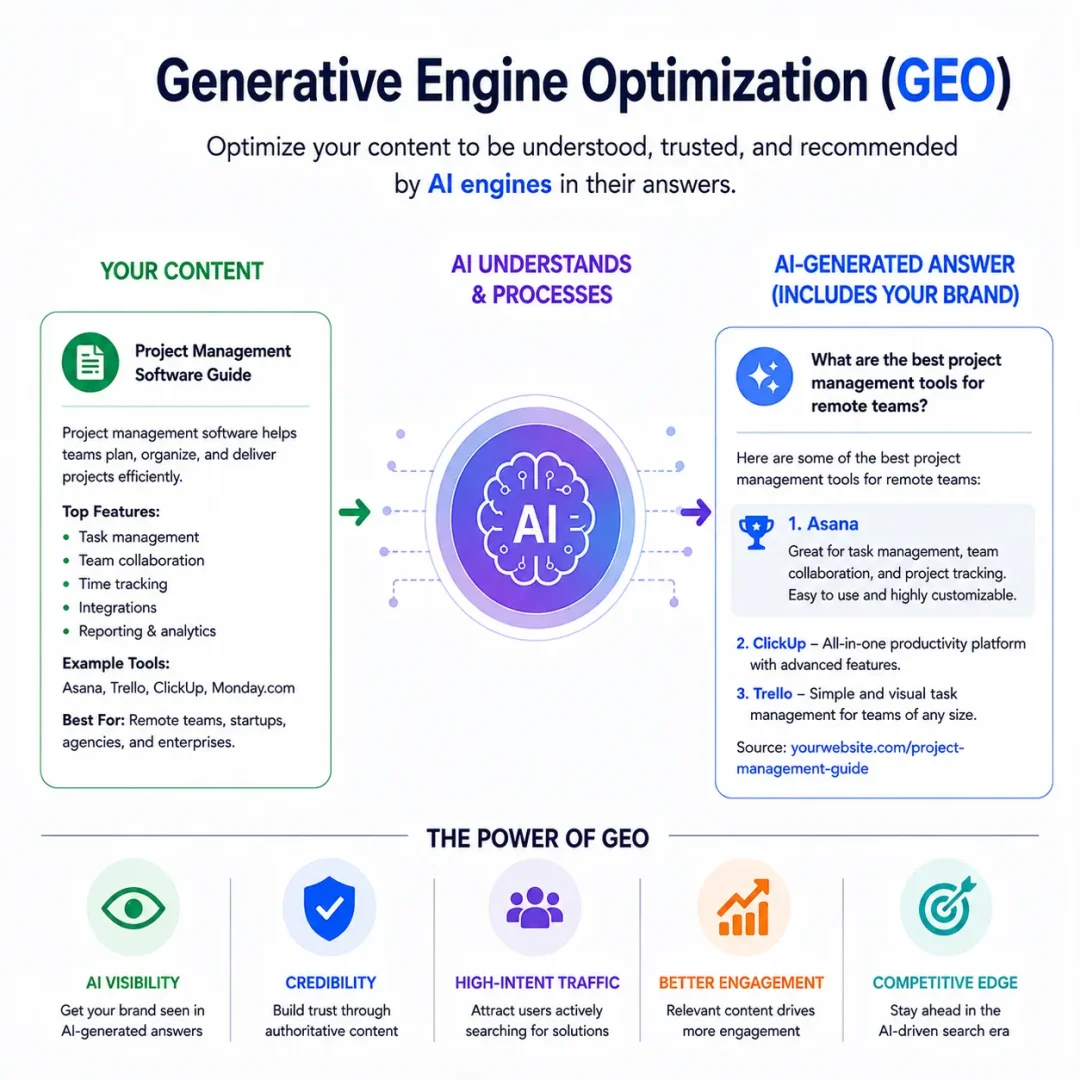
GEO stands for Generative Engine Optimization. It is also called Answer Engine Optimization (AEO) or AI Search Optimization. The goal is simple: get AI-powered search engines like ChatGPT, Perplexity, and Gemini to cite and recommend your business.
The way people search for products and services changed dramatically between 2024 and 2026. Rather than typing keywords into Google and scanning ten blue links, a growing share of buyers now open ChatGPT, Perplexity, Google Gemini, or Claude and ask a direct question: “Which digital marketing agency should I hire for Shopify SEO?” or “Who manages Google Ads for dental practices in the USA?” These AI engines do not return a list of links. They synthesize information from hundreds of sources and produce a single, confident answer — recommending specific businesses, quoting specific statistics, and citing trusted sources.
If your business is not optimized for AI search, it does not appear in these answers. It does not matter how good your service is or how many years you have been in business — if the AI has not indexed your content, cannot understand your expertise, or does not trust your authority, you are invisible to a rapidly growing segment of your target market.
GEO bridges that gap. It is the set of technical, content, and authority-building strategies that make your website readable, trustworthy, and citation-worthy for every major AI search engine. Done correctly, GEO results in your brand being recommended by ChatGPT when someone asks about your service category, cited by Perplexity in research queries, and suggested by Gemini in local business searches.
The AI Search Landscape
Understanding where your audience is searching is the foundation of any effective marketing strategy. In 2026, the search landscape looks fundamentally different from even two years ago. Google remains important, but AI-powered answer engines have captured a significant and growing share of research and buying-intent queries.
ChatGPT now has over 200 million daily users. Perplexity is the go-to research tool for professionals. Google’s AI Overviews top the results page for most queries — cutting organic clicks. And Microsoft Copilot is built into the tools millions of businesses already use every day.
According to research published in early 2026, AI visitors convert at 4.4 times the rate of standard organic search visitors. The explanation is straightforward: a person who asks ChatGPT “which agency should I hire for Shopify SEO in Chicago?” and receives a recommendation for Clicks2Success has already been pre-qualified by the AI. They arrive at your website with a high level of intent and trust. This is fundamentally different from a user who finds a generic search result and clicks out of curiosity.
The strategic implication is clear: ranking in AI search is not just a nice-to-have for 2026 — it is a core acquisition channel. Businesses that optimize for AI visibility now are building a compound advantage over competitors who are still focused exclusively on traditional SEO.
Our Full-Stack GEO & AI Search Optimization Services
Technical GEO Audit and AI Crawl Access Setup
The first step in any GEO activity is ensuring that every major AI crawler can access, read, and understand your website. This is more complex than it sounds. Many websites block AI bots accidentally through overly restrictive robots.txt rules. Others hide critical content behind JavaScript that AI crawlers cannot execute. Some use CDN configurations — particularly Cloudflare — that block AI user agents by default.
Our GEO audit checks every layer of your site for AI access. We test five major crawlers: GPTBot (ChatGPT), ClaudeBot (Claude), PerplexityBot, Google-Extended (Gemini), and Applebot-Extended (Apple Intelligence). If any of them can’t read your site, we fix it.
Beyond access, we audit and create your llms.txt file — a structured, human-readable document published at your root domain that tells AI systems what your business does, which pages are most important, what services you offer, and how to correctly represent your brand in AI responses. As of 2026, fewer than 5% of business websites have an llms.txt file, making its presence a meaningful competitive advantage.
| Technical audit covers | AI crawlers we verify |
|---|---|
| robots.txt AI crawler access check | GPTBot — ChatGPT (OpenAI) |
| llms.txt file creation and optimization | ClaudeBot — Claude (Anthropic) |
| XML sitemap accuracy and freshness | PerplexityBot — Perplexity AI |
| JavaScript rendering and content visibility | Google-Extended — Gemini (Google) |
| CDN and server-side AI bot configuration | Applebot-Extended — Apple Intelligence |
| Page structure and content accessibility | Bingbot — Microsoft Copilot |
| Page structure and content accessibility | OAI-SearchBot — OpenAI SearchGPT |
| HTTPS and security certificate validation | Amazonbot — Alexa AI |
AI-Optimized Content Strategy and Rewriting
Content is the core of GEO. AI engines synthesize their answers from published content — they extract specific facts, statistics, definitions, and expert opinions from trusted sources and weave them into a coherent response. Your content must be structured and written in a way that makes it easy for AI systems to extract, understand, and cite.
Traditional SEO content is often written to rank for a specific keyword phrase — it satisfies a search algorithm’s relevance scoring. GEO content must go further. It needs to directly answer the specific questions your target audience asks AI engines. It needs to cite verifiable statistics. It needs to present expert opinions with proper attribution. It needs to be structured with clear headings, logical progression, and scannable formatting. And it needs to be trusted — written by a named expert with real credentials, not anonymous marketing copy.
We audit your existing content against these criteria and produce a complete rewriting plan. For your top ten service and landing pages, we rewrite the content to meet AI citation standards. For your blog, we identify the highest-impact topics based on what your target audience is asking AI engines and produce a 90-day content calendar that step by step builds your authority across your service areas.
Every piece of GEO-optimized content we produce includes: a clear direct answer to the primary question within the first 150 words (because AI engines favor content that leads with answers), at least three data points with cited sources, structured FAQ sections that map to real user queries, H2 and H3 headings that mirror natural language questions, and a concluding expert recommendation that reinforces your brand authority.
Schema Markup setup for AI Extraction
Schema markup is structured data code embedded in your website’s HTML that provides AI engines and search engines with machine-readable information about your content. While traditional SEO benefits from basic Organization and WebPage schema, GEO requires a more comprehensive schema implementation that maps directly to the types of questions AI engines answer.
FAQ schema is the single highest-impact schema type for GEO. When your service pages and blog posts include properly formatted FAQ schema, AI engines can directly extract question-and-answer pairs and include them verbatim in their responses. This is one of the most reliable ways to get your brand’s specific language into AI-generated answers. We implement FAQ schema on every service page, every blog post, and every location landing page on your website.
Beyond FAQ schema, we implement the complete suite of schema types relevant to a digital marketing agency: LocalBusiness schema with verified address, phone number, service areas, and operating hours; Service schema that describes each of your individual service offerings in structured format; Organization schema with official certifications (Google Premier Partner, Shopify Partner), founding date, and social profiles; and Review and AggregateRating schema that surfaces your client testimonials to AI engines as trust signals.
| Schema types we implement | Impact on AI visibility |
|---|---|
| FAQ schema on all service pages | Exact Q&A extracted by ChatGPT |
| LocalBusiness with full NAP data | Local business recommendations by Gemini |
| Service schema per offering | Service-specific AI citations |
| Organization with certifications | Brand authority recognition by LLMs |
| Review / AggregateRating schema | Trust signals in AI responses |
| BreadcrumbList for site structure | Content structure understood by AI |
| WebSite with search action | Site-wide relevance signals |
| Article schema for blog posts | Blog content indexed and cited by AI |
E-E-A-T Enhancement and Author Authority Building
Google’s E-E-A-T standard — Experience, Expertise, Authoritativeness, Trustworthiness — launched in 2022. By 2026, it also drives AI citation decisions. AI engines favour content from named human experts with real credentials. Anonymous branded copy ranks lower and gets cited less.
We audit your website’s E-E-A-T signals and implement a structured enhancement plan. This includes creating detailed author bio pages for every person who writes content on your website, with professional photographs, credential listings, years of experience, and links to external profiles on LinkedIn and industry publications. We add bylines to every blog post and service page. We create a detailed About Us page that tells the story of the agency, the certifications held, the clients served, and the results achieved.
Case studies are one of the most powerful E-E-A-T signals available to a digital marketing agency. A case study that shows a specific client, a specific problem, a specific strategy, and specific measurable results is exactly the type of content AI engines favor for citation — because it contains verifiable, original data that cannot be found elsewhere. We help you structure and publish at least three detailed case studies as standalone pages, each with enough specificity to serve as cited evidence in AI-generated answers about digital marketing results.
Citation and Brand Authority Network Building
AI engines evaluate your brand’s authority in part by measuring how consistently and positively you appear across authoritative external sources. A business that appears on Clutch with positive reviews, is listed on GoodFirms with verified client feedback, is mentioned in Search Engine Journal articles, and has a verified Google Business Profile with recent reviews is greatly more likely to be recommended by AI than a business that exists only on its own website.
We build your brand’s citation and authority network step by step. We submit your agency to the fifteen most important B2B agency directories — Clutch, GoodFirms, UpCity, AgencySpotter, Expertise.com, DesignRush, and others — with consistent, complete profile information. We identify HARO (Help a Reporter Out) and Qwoted journalist requests relevant to digital marketing and respond on your behalf to earn earned media mentions. We identify guest posting opportunities on Search Engine Journal, Moz, HubSpot, and similar publications and develop pitches that secure placements.
Each external mention, citation, and backlink strengthens the signal that AI engines receive about your brand’s authority. The cumulative effect over six to twelve months is a brand that AI engines recognize as a trusted, established expert in digital marketing — and therefore recommend with confidence.
AI Visibility Monitoring, Measurement and Reporting
One of the most important differences between GEO and traditional SEO is the measurement framework. SEO success is measured by keyword rankings, organic traffic volume, and click-through rates. GEO success is measured by AI share of voice — how frequently your brand is mentioned when AI engines answer queries relevant to your service category — and by the quality and accuracy of those mentions.
We track your brand’s AI share of voice weekly across ChatGPT, Perplexity, Claude, and Google Gemini using a defined set of 30 to 50 commercially relevant prompts. Each week we test prompts like “best digital marketing agency for Shopify stores in the USA,” “who provides GEO and AI search optimization services,” and “recommended Google Ads agency for dental practices” and record whether Clicks2Success appears, in what position, and with what description.
We also configure Google Analytics 4 to capture AI-referred traffic as a distinct channel, separating it from general organic traffic. This allows you to see the direct revenue contribution of GEO activity — how many website visits, lead form submissions, and consultation bookings originated from AI-referred traffic each month.
Your monthly GEO report includes: AI share of voice score across all four engines, week-over-week trend data for each prompt category, GA4 AI traffic and conversion data, new citations and brand mentions identified during the month, and a prioritized action list for the following month.
GEO vs Traditional SEO: Understanding the Difference
A common question from clients is whether GEO replaces traditional SEO or runs alongside it. The answer is that GEO and SEO are work together disciplines that reinforce each other — strong traditional SEO authority makes GEO more effective, and GEO-optimized content often also improves traditional search rankings.
The key difference is the optimization target. Traditional SEO optimizes for a search engine’s ranking algorithm — it scores pages based on keyword relevance, backlink authority, page experience metrics, and user engagement signals. GEO optimizes for an AI engine’s citation decision — it structures content for easy to extract, builds brand authority signals that AI systems recognize, and ensures technical accessibility for AI crawlers.
In practical terms, a well-optimized service page for GEO will: lead with a direct, concise answer to the primary question; include structured FAQ sections; cite data with source attribution; be written by a named author with verifiable credentials; and include comprehensive schema markup. These characteristics also tend to improve traditional SEO performance, because Google’s Helpful Content system rewards exactly this type of authoritative, user-first content.
Our recommendation for most clients is a combined SEO + GEO strategy, particularly if they are starting from a relatively new domain or low Domain Rating baseline. Building traditional SEO authority accelerates GEO citation rates, and GEO-optimized content accelerates traditional ranking improvements.
Industries We Serve
Clicks2Success delivers GEO services to businesses across ten industry verticals. Our strategies are adapted to the specific questions your target audience asks AI engines and the specific authority signals that matter in your sector.
- Fashion & Apparel
- Beauty & Personal Care
- Health & Wellness
- Food & Beverage
- Home & Lifestyle
- Sports & Fitness
- Electronics & Technology
- Subscription Box Businesses
- B2B & Wholesale eCommerce

Frequently Asked Questions About GEO & AI Search Optimization"
What is Generative Engine Optimization (GEO) and why does my business need it in 2026?
GEO is optimizing your website so AI engines like ChatGPT, Perplexity, and Gemini cite and recommend your brand. In 2026, over 50% of adults use AI for buying decisions. Without GEO, your business is invisible to that audience — no matter how strong your traditional SEO is.
How is GEO different from SEO, and do I need both?
SEO targets Google's ranking algorithm. GEO targets AI citation signals — content structure, data citations, schema markup, and brand authority. You need both: strong SEO improves GEO performance, and GEO-optimized content also helps Google rankings. They work best together.
How long does it take to see GEO results?
Technical fixes (robots.txt, llms.txt, schema) are live within two weeks. AI citation improvements typically appear within 60–90 days for less competitive queries, and 90–180 days for competitive terms. AI share of voice grows steadily as content and authority build.
Can small and local businesses benefit from GEO?
Yes — local businesses often benefit most. When someone asks ChatGPT 'which dental agency should I hire in Chicago?' the AI recommends the most credible, local, specialized option — not the biggest brand. Local schema, GBP optimization, and city landing pages are key.
What does a monthly GEO retainer with Clicks2Success include?
Every month: llms.txt and schema maintenance, content optimization of 2–4 pages, 2–4 new directory citations, weekly AI share of voice tracking across ChatGPT, Perplexity, Claude, and Gemini, GA4 AI traffic reporting, and a strategy call with your account manager.
Do you provide GEO alongside SEO, Google Ads, and CRO?
Yes — and the combined approach delivers the best results. Clicks2Success is a full-stack agency covering GEO, SEO, Google Ads, ChatGPT Ads, CRO, Shopify Development, and Marketing Automation. Each channel reinforces the others through one unified strategy.
How do you measure GEO ROI?
Four metrics: (1) AI share of voice — how often your brand appears across 30–50 target prompts weekly; (2) AI-referred traffic in GA4; (3) AI-referred lead conversions; (4) brand mention growth across external sources. Full monthly reporting with trend data included.