
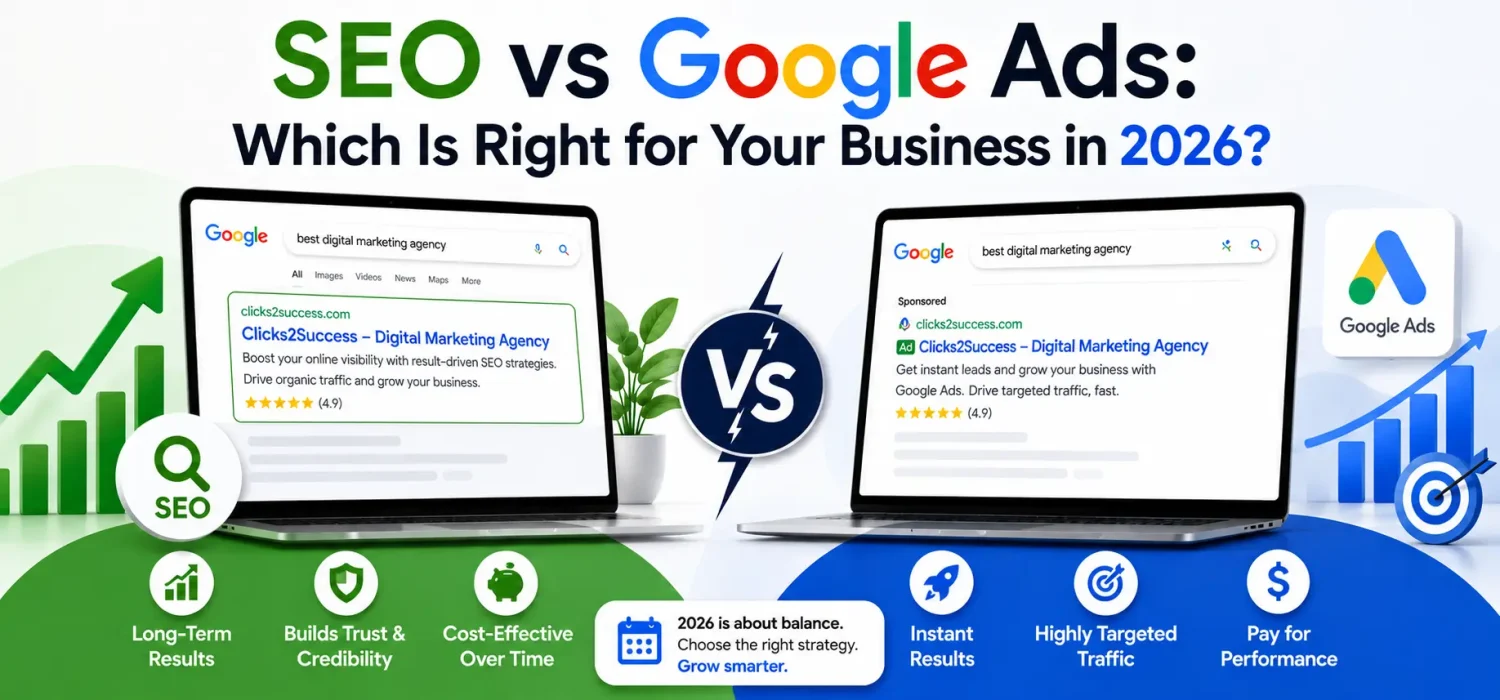
SEO vs Google Ads: Which Is Right for Your Business in 2026?
- June 10, 2026
- B_Siddharth
- 9:58 am
If you’ve ever sat down to plan your marketing budget and felt stuck choosing between SEO and Google Ads, you’re not alone. It’s one of the most common questions business owners ask us at Clicks2Success — and honestly, there’s no single right answer. The best choice depends on your goals, your timeline, and your budget.
In this guide, we’ll break down both strategies in plain English, show you exactly when to use each one, and help you decide which is the smarter investment for your business right now.
What Is SEO and How Does It Work?
SEO, or Search Engine Optimization, is the process of improving your website so it appears higher in Google’s unpaid (organic) search results. When someone searches “best dentist in Chicago” or “affordable Shopify development agency,” the websites that show up on page one didn’t pay Google to be there — they earned those spots through strong SEO.
SEO involves several moving parts:
- Technical SEO — making sure your website loads fast, is mobile-friendly, and is easy for Google to crawl.
- On-Page SEO — using the right keywords in your page titles, headings, and content.
- Content Marketing — publishing helpful blog posts, guides, and service pages that answer what your customers are searching for.
- Link Building — earning mentions and links from other reputable websites, which tells Google you’re trustworthy.
The big advantage of SEO?
Once your pages rank, the traffic is essentially free.
The trade-off?
SEO takes time — most businesses start seeing meaningful results within 3–6 months, with the best results coming at the 6–12 month mark.
What Is Google Ads and How Does It Work?
Google Ads (also called Pay-Per-Click or PPC) lets you pay to show your business at the top of Google search results immediately. You bid on keywords, create ads, and pay Google each time someone clicks.
Google Ads also includes:
- Search Ads — text ads that appear at the top of Google search results.
- Shopping Ads — product listings for e-commerce stores.
- Display Ads — banner ads shown across millions of websites.
- Retargeting — showing ads to people who already visited your website.
The key advantage of Google Ads is speed. You can generate leads the same day you launch a campaign. The downside is cost — you pay for every click, and costs can add up fast.
SEO vs Google Ads: A Side-by-Side Comparison:
| Factor | SEO | Google Ads |
|---|---|---|
| Speed | 3–12 months to rank | Results in days |
| Cost | Time & content investment | Pay per click (ongoing) |
| Long-term value | Traffic grows over time | Stops when budget runs out |
| Trust | Users trust organic results more | Clearly labelled as Sponsored results |
| Competition | Based on content & authority | Based on budget & bid |
| Best for | Long-term brand building | Fast leads & promotions |
When Should You Invest in SEO?
- You’re in it for the long game. SEO compounds over time. The content and authority you build in year one keeps delivering traffic in year three and beyond.
- You want to reduce your dependence on paid ads. SEO gives you a way out — building traffic you own rather than rent.
- You want to build trust and authority. Customers trust organic results more than ads. Ranking on page one signals that Google considers you an authority.
- Your sales cycle is longer. For B2B software, legal services, or Shopify development, content-driven SEO reaches buyers during their research phase.
When Should You Run Google Ads?
- You need leads now. If your business is new, launching a product, or running a limited-time offer, Google Ads gets you in front of buyers immediately.
- Your margins support a cost-per-click model. If you’re selling a $5,000 service, paying $10–30 per click is often very profitable.
- You want to test messaging first. Running ads lets you see which keywords and value propositions actually convert — then double down with SEO.
- You’re in a seasonal business. Google Ads lets you turn traffic on and off based on your calendar.
The Smarter Answer: Use Both Together
Think of it like this — Google Ads is a water tap. Turn it on, water flows. Turn it off, it stops. SEO is a well you dig. It takes time and effort, but once it’s there, the water flows consistently without you paying for every drop.
- Month 1–3: Launch Google Ads for immediate lead generation. Start technical SEO fixes and publish foundational content.
- Month 3–6: Analyse which ad keywords convert best. Build SEO content around those same keywords.
- Month 6–12: As organic rankings improve, reduce ad spend on terms you’re ranking for organically.
- Year 2+: SEO delivers consistent organic traffic. Google Ads focuses only on high-value competitive terms.
How Much Should Your Budget?
For Google Ads: most small-to-medium businesses need a minimum of $1,000–$3,000/month in ad spend, plus management fees. Competitive industries can require $5,000+ per month.
For SEO: a professional SEO engagement typically runs $ 500–$5,000/month depending on competition and goals. Unlike ad spend, SEO builds an asset — your rankings — that keeps delivering value.
We Suggests:
- Choose Google Ads if you need leads in the next 30–90 days and your budget supports it.
- Choose SEO if you’re willing to invest for 6–12 months in exchange for traffic that doesn’t disappear when your budget does.
But if you can do both — even at a small scale — you’ll grow faster and build a more resilient business.
Ready to grow your business with the right strategy?
FAQs
Can I do SEO and Google Ads at the same time?
Yes — and it's often the smartest move. Ads give you leads now while SEO builds long-term traffic.
How long does SEO take to work?
Most businesses see results in 3–6 months, with stronger rankings at the 6–12 month mark.
Is Google Ads worth it for small businesses?
Yes, if your margins support it and campaigns are set up correctly. A Google-certified agency helps ensure you're not wasting budget.
Does running Google Ads help my SEO rankings?
No — paid ads don't directly boost organic rankings.
What's a good ROAS for Google Ads?
3–5x is healthy for most industries. E-commerce brands typically target 4–8x.