
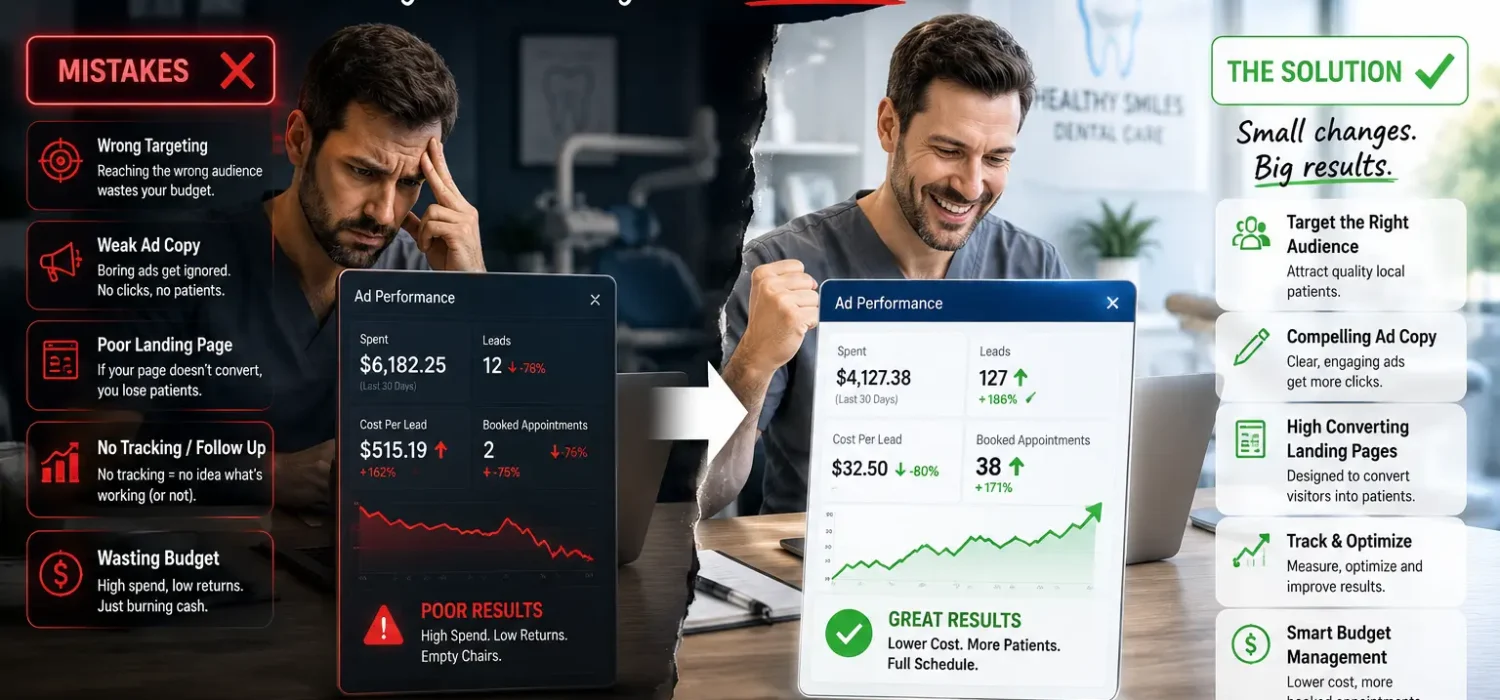
You're Running Dental Ads — But Are You Just Burning Cash?
- May 29, 2026
- B_Siddharth
- 11:31 am
Here’s What’s Actually Going Wrong
Most US dental clinics are making the same dental advertising mistakes — and losing thousands of dollars every month without realising it. The painful truth? The problem isn’t the platform. It’s not Google. It’s not Meta. It’s three fixable dental advertising mistakes — and they’re costing practices thousands in wasted spend every year.
In this guide, we’re pulling back the curtain on exactly where your ad budget is disappearing, what a properly built campaign looks like, and the step-by-step framework that helped one suburban Chicago practice acquire 41 new patients in 90 days — at just $80 per patient.
Add Your Heading Text Here
The 3 Dental Advertising Mistakes Draining Your Budget Right Now
Mistake #1: Your Ads Are Showing to People Who Will Never Walk Through Your Door
- The Fix: Tighten your geographic targeting to a 5–15 mile radius around your clinic. In dense metro areas like Chicago or Los Angeles, shrink that to 3–5 miles. Every dollar saved from irrelevant clicks is a dollar that can reach a genuine potential patient.
- The Fix: Every ad campaign needs its own dedicated landing page. Match the ad’s message exactly — if the ad says ‘dental implants,’ the landing page headline must say ‘dental implants.’
- Google Ads Conversion Tracking — tracks calls and form fills from Google Ads
- Meta Pixel — tracks website actions from Facebook and Instagram Ads
- CallRail — assigns unique phone numbers to each ad source so you know which ad generated which call
- Google Analytics 4 — ties all traffic sources together in one dashboard
How Google Search Ads Work for Dentists
Unlike social media ads that interrupt someone mid-scroll, Google Search Ads appear at the exact moment a patient is actively searching for your service — which is why conversion rates are significantly higher.
Keyword Categories That Drive the Best Results
| Category | Example Keywords | Intent Level |
|---|---|---|
| Emergency | emergency dentist near me", "toothache relief [city]" | Highest — Book Now |
| Treatment | dental implants [city]", "Invisalign [city]" | High — Ready to Buy |
| General Practice | family dentist [zip]", "dentist accepting new patients" | Medium — Exploring |
In most US markets, cost-per-click ranges from $4–$15 for general terms and climbs to $20–$45 per click for high-value treatment keywords like implants in competitive cities.
> The Hidden Gem: Google Local Services Ads (LSA)
LSA is a separate Google product designed specifically for local service businesses — including dentists. Unlike traditional Google Ads, you pay per verified lead (phone call or message), not per click. LSAs appear above regular search ads and display your Google rating plus a ‘Google Screened’ badge, dramatically increasing trust.
For dental practices, LSA costs typically range from $20–$80 per verified lead — making it one of the most cost-efficient paid channels available. Every US dental clinic should have LSA running alongside traditional Search Ads.
> Meta Ads for Dental Practices
While Google captures patients who are already searching, Meta Ads (Facebook and Instagram) let you reach patients before they start searching — building awareness for high-value treatments they may not have considered yet.
> When Meta Ads Work Best for Dentists
- Cosmetic treatments — teeth whitening, veneers, Invisalign, smile makeovers
- New patient offers — “$99 new patient exam, X-rays & cleaning” promotions
- Seasonal campaigns — back-to-school checkups, holiday smile campaigns
- Retargeting — showing ads to people who visited your website but didn’t book
> HIPAA Compliance Notice
US dental advertisers must NOT upload patient lists or health-related custom audiences to Meta — this can violate HIPAA guidelines. Use only pixel-based website data and interest targeting. Always work with an agency experienced in healthcare advertising compliance.
Ad Creative That Actually Converts
- Before-and-after smile photos (with signed patient consent forms documented)
- Short video testimonials from satisfied patients (60–90 seconds)
- “Limited spots available” new patient offers with a clear dollar value
- Educational carousel ads explaining a treatment step by step
Which Dental Treatments to Advertise First (Ranked by ROI)
Start with treatments that generate the highest revenue per patient — so that even a handful of conversions covers your entire month’s ad budget.
| Treatment | Value Per Patient | Best Platform | Target Audience |
|---|---|---|---|
| Dental Implants | $3,000–$6,000 | Google + Meta | Ages 45–70, homeowners |
| Invisalign | $3,000–$8,000 | Google + Instagram | Adults 25–45 |
| Teeth Whitening | $300–$1,500 | Meta Ads | Volume/loss leader |
| Veneers | $1,000–$2,500/tooth | Instagram + Facebook | Higher-income demographics |
| New Patient Exam | $99–$149 offer | Both platforms | All new movers to area |
Landing Pages — What Turns a Click Into a Booked Appointment
Your ad is only half the equation. The page a patient lands on determines whether they book or bounce.
Above the Fold (Visible Without Scrolling)
- Headline matching the ad exactly — if the ad says “dental implants,” the page says “dental implants”
- Prominent click-to-call phone number for mobile users
- Online booking button or short contact form (name, phone, preferred time — nothing more)
- Your Google star rating and review count for immediate trust
Below the Fold
- 3–5 genuine patient before-and-after photos (with consent)
- A brief video from the dentist — 60 to 90 seconds, friendly and reassuring
- A clear price range or ‘free consultation’ offer
- FAQs addressing the most common patient objections
- Your credentials, years of experience, and relevant certifications
- An embedded Google Map showing your location
Mobile-First Warning
Over 65% of dental ad clicks in the US happen on mobile devices. If your landing page isn’t fast and clean on a smartphone, you’re losing the majority of your ad investment. Page load time should be under 3 seconds — check yours free at Google PageSpeed Insights.
US Budget Guide — What $1,000 to $5,000/Month Gets You
One of the most common questions dental practice owners ask is: how much should I spend on ads?
Here’s a realistic breakdown for US practices:
| Treatment | Value Per Patient | Best Platform | Target Audience |
|---|---|---|---|
| Dental Implants | $3,000–$6,000 | Google + Meta | Ages 45–70, homeowners |
| Invisalign | $3,000–$8,000 | Google + Instagram | Adults 25–45 |
| Teeth Whitening | $300–$1,500 | Meta Ads | Volume/loss leader |
| Veneers | $1,000–$2,500/tooth | Instagram + Facebook | Higher-income demographics |
| New Patient Exam | $99–$149 offer | Both platforms | All new movers to area |
Recommended Budget Split: For most practices, a 70/30 split works well — 70% on Google (higher intent) and 30% on Meta (awareness and cosmetic treatments).
Agency Management Fees: Expect an additional $500–$1,500/month in management fees on top of ad spend. A quality agency should generate a return that makes this easy to justify.
Tracking ROI — The Metrics That Matter
| Metric | Benchmark | Why It Matters |
|---|---|---|
| Cost Per Click (CPC) | $5–$45 depending on treatment | Measures ad efficiency |
| Cost Per Lead (CPL) | $30–$80 per lead | Shows lead quality |
| Lead-to-Appointment Rate | 30–50% with prompt follow-up | Measures sales conversion |
| Cost Per Acquisition (CPA) | $300–$600 for implants | Real patient cost |
| Return on Ad Spend (ROAS) | 5:1 or higher | $1 in = $5+ in revenue |
Real Results: 41 New Patients in 90 Days
Practice: Family & Cosmetic Dental Group, suburban Chicago, IL
Situation: 2 dentists, established practice, slow new patient acquisition, no paid advertising running.
Budget: $2,500/month ad spend + $800/month management
Results After 90 Days
| Channel | Clicks / Leads | Booked Appointments |
|---|---|---|
| Google Search Ads | 380 clicks, 41 leads | 18 appointments |
| Google LSA | 22 verified leads | 14 appointments |
| Meta Ads | 1,100 clicks, 28 leads | 9 appointments |
| TOTAL | 91 leads | 41 new patients |
Cost per new patient across all channels: $80.49
Implant consultations booked: 6 (potential revenue: $18,000–$36,000)
Return on ad spend: 12:1 — every $1 spent returned $12 in treatment revenue.
FAQs
Why are my dental ads wasting money?
The three most common culprits are targeting too broad a geography, sending clicks to a generic homepage instead of a treatment-specific landing page, and running ads without conversion tracking.
Which platform should I advertise on Google or Meta?
Use both, but for different goals. Google captures patients actively searching for a dentist. Meta builds awareness for cosmetic treatments like Invisalign and veneers. A 70/30 budget split (Google/Meta) is a proven starting point.
What is Google LSA and is it worth it?
Google Local Services Ads charge per verified lead ($20–$100), not per click. They appear above regular search results with a trust badge — making them one of the most cost-efficient channels for dental practices.
How much should I spend on ads monthly?
A solo or small practice can start at $2,000–$2,500/month. Growing suburban practices typically spend $3,000–$4,000/month, while multi-provider or metro practices invest $5,000–$6,000/month or more.
Which treatments should I advertise first?
Start with high-value treatments — dental implants, Invisalign, and veneers offer the strongest ROI. New patient exam offers (e.g., "$149 exam + X-rays + cleaning") work well as an entry point to build long-term patient relationships.
What ROI should I realistically expect?
A healthy benchmark is 5:1 ROAS — $1 in ad spend returning $5 in treatment revenue. Well-optimised campaigns with proper tracking can exceed this significantly.
Do I need to worry about HIPAA when running dental ads?
Yes. Never upload patient lists or health-related data to Meta. Stick to website pixel data and interest-based targeting, and work with an agency familiar with healthcare ad compliance.