
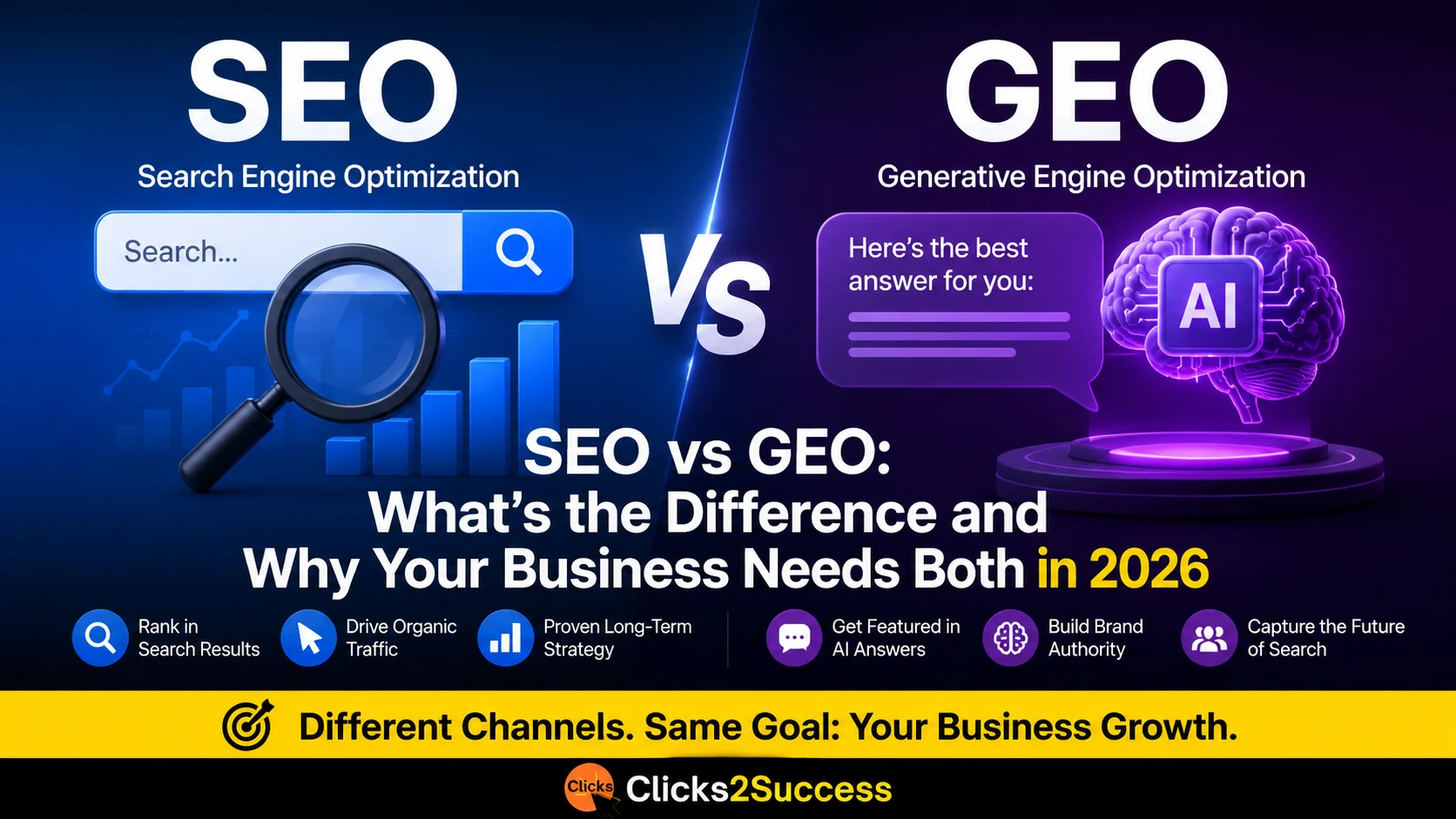
SEO vs GEO: What's the Difference and Why Your Business Needs Both in 2026
- June 17, 2026
- B_Siddharth
- 1:25 pm
For the past decade, the rules of online visibility were simple: rank on Google, get traffic. Build backlinks, write keyword-rich content, optimise your title tags — and the clicks would follow.
That playbook still works. But it’s no longer the whole game.
A new search behaviour is quietly reshaping how people find businesses online. Instead of typing a query into Google and clicking through links, a growing number of people are asking ChatGPT, Perplexity, Google’s AI Overview, or Microsoft Copilot — and getting one synthesised answer without ever visiting a website.
If your business isn’t optimised to appear in those AI-generated answers, you’re becoming invisible to a fast-growing segment of your market. That’s what GEO — Generative Engine Optimisation — solves
What Is SEO? (A Quick Refresher)
SEO (Search Engine Optimization) is the practice of optimising your website to rank higher in traditional search engines — primarily Google and Bing.
When someone searches “digital marketing agency in Chicago,” Google evaluates hundreds of ranking signals — your page’s relevance, load speed, backlinks, content quality, mobile experience, and more — and serves up a list of results. SEO is the work of making your website the most relevant and trustworthy option for that search.
SEO drives traffic through clicks. A strong SEO strategy builds a sustainable, long-term source of organic traffic that you own — unlike paid ads that stop the moment your budget runs out.
What Is GEO? (The New Game in Town)
GEO(Generative Engine Optimization) is the practice of optimising your content so that AI-powered platforms — ChatGPT, Perplexity, Google AI Overviews, Microsoft Copilot, Gemini — cite your brand as a trusted source when they generate answers.
When someone asks ChatGPT “what’s the best digital marketing agency for e-commerce?”, these AI engines don’t show a list of 10 links. They synthesise an answer from multiple sources and may — or may not — mention your brand.
GEO is the discipline of making sure your brand gets mentioned, cited, and recommended in those AI-generated responses.
The key difference: SEO wins you a ranking. GEO wins you a citation.
Why GEO Matters Right Now
The numbers explain why this shift is impossible to ignore:
- ChatGPT now processes 2.5 billion prompts every day — and 65% of those qualify as search queries.
- Google’s AI Overviews now appear in roughly 50% of all US search queries.
- When AI Overviews appear, the top-ranked organic result loses up to 34% of its expected clicks.
- ChatGPT referral traffic converts at 15.9% — compared to 1.76% for standard Google organic traffic. That’s nearly 9x higher.
SEO vs GEO: The Key Differences
| SEO | GEO | |
|---|---|---|
| Goal | Rank in Google/Bing results | Get cited in AI-generated answers |
| Platforms | Google, Bing, Yahoo | ChatGPT, Perplexity, Gemini, Copilot |
| How it works | Keywords, backlinks, technical signals | Authority, content structure, entities |
| Result | A clickable link in search results | A mention inside an AI answer |
| Traffic type | Click-based | Recommendation-based |
| Timeline | 3–12 months to rank | Ongoing — AI updates continuously |
| Key metrics | Rankings, organic traffic, CTR | Citation frequency, brand mentions |
| Content style | Keyword-optimised, long-form | Authoritative, structured, citable |
How AI Engines Decide What to Cite
AI engines like ChatGPT and Perplexity scan for consensus signals — they look for consistent information about a brand or topic across multiple independent sources. If your business appears across your website, industry publications, review platforms, forums, and directories — all with consistent messaging — AI systems gain confidence in recommending you.
If you only exist on your own website with no external validation, AI engines default to more established brands that have broader third-party presence.
Here’s what research shows AI platforms specifically look for:
- Authoritative, clearly structured content. AI engines prefer content that answers questions directly with clear headings and easy-to-extract facts.
- E-E-A-T signals. Experience, Expertise, Authoritativeness, and Trustworthiness — the same signals Google uses — matter just as much for AI citation.
- Schema markup and structured data. FAQ schema, How-To schema, and Organisation schema make your content easier for AI crawlers to understand.
- Third-party mentions and reviews. Appearing on Clutch, G2, Google Reviews, and industry directories creates the external validation AI systems use to confirm credibility.
- Freshness. Perplexity in particular heavily weights recently updated content. Keeping your pages current matters more than ever.
Practical GEO Tactics: What to Actually Do
AI engines love content that gives a clear, direct answer to a specific question. Structure your blogs and service pages with H2s framed as questions. Answer each one concisely and clearly, then expand with supporting detail.
Create or claim profiles on Clutch, G2, UpCity, and Trustpilot. Encourage clients to leave Google reviews. Get your agency mentioned in industry publications. The more credible, independent sources that mention your brand, the stronger your citation signals become.
FAQ schema makes pages 3.2x more likely to appear in Google AI Overviews, according to research. Most WordPress SEO plugins like RankMath or Yoast make it easy to add without touching code.
Traditional SEO thinks in keywords. GEO thinks in entities — specific people, businesses, places, and concepts that AI systems can clearly identify. Make sure your website clearly establishes who you are, what services you provide, where you operate, and what results you’ve achieved.
Check your robots.txt file to make sure you’re not accidentally blocking AI crawlers. ChatGPT uses GPTBot, Perplexity has its own crawler. If AI platforms can’t crawl your site, they can’t cite it.
Does SEO Still Matter in 2026?
Absolutely — and this is critical to understand.
Google still processes 14 billion searches per day. ChatGPT handles 37 million. Google’s volume is 373x larger. Traditional search is not dead — not even close.
Moreover, strong SEO is actually the foundation of good GEO. Google’s AI Overviews heavily favour content that already ranks in the top 10 organically. The two disciplines reinforce each other.
The brands winning in 2026 aren’t abandoning SEO for GEO. They’re layering GEO on top of their existing SEO foundation — making their content more citable, more authoritative, and more structured for the AI layer of the web.
What a Combined SEO + GEO Strategy Looks Like
Step 1 — Strengthen SEO Fundamentals: Technical health, fast load speeds, clean site structure, high-quality content, and authoritative backlinks. This remains the non-negotiable foundation.
Step 2 — Restructure Content for AI Extractability: Add direct Q&A sections, clear H2 headings, specific statistics, and FAQ schema markup to existing content.
Step 3 — Build the External Footprint: Systematically earn reviews, directory listings, press mentions, and backlinks from credible sources.
Step 4 — Monitor AI Visibility: Track how often your brand appears in AI-generated answers using tools like Profound or Brand Mentions, or by manually testing ChatGPT and Perplexity.
Step 5 — Keep Content Fresh: Build a calendar to refresh key pages and publish new, research-backed content consistently.
Where This Leaves You
SEO and GEO are not competing strategies — they’re two layers of the same visibility challenge.
SEO ensures you show up when people search on Google. GEO ensures you get cited when people ask an AI. The businesses that will dominate organic and AI-driven discovery in the next three to five years are the ones building both, starting now.
FAQs
Is GEO replacing SEO?
No. SEO and GEO work together. Traditional search still dominates volume — GEO adds visibility in AI platforms on top of it.
How do I know if my brand is being cited in AI answers?
Test manually by asking ChatGPT, Perplexity, and Gemini questions your customers would ask. Tools like Profound and BrandMentions can automate this tracking.
Do I need a separate strategy for each AI platform?
The fundamentals are the same across platforms. Specific nuances (Perplexity favours fresh content, ChatGPT favours established brands) can guide prioritisation.
How quickly does GEO work?
There's no fixed timeline — AI models update their knowledge continuously. Building strong authority signals consistently is more important than expecting results in a set timeframe.
Does adding FAQ schema really make a difference?
Yes — research shows pages with FAQ schema are 3.2x more likely to appear in Google AI Overviews. It's one of the quickest, highest-impact GEO wins available