ChatGPT Ads Management Services
Advertise on the Platform That 200 Million People Use to Research, Ask & Buy Every Day
What Are ChatGPT Ads?
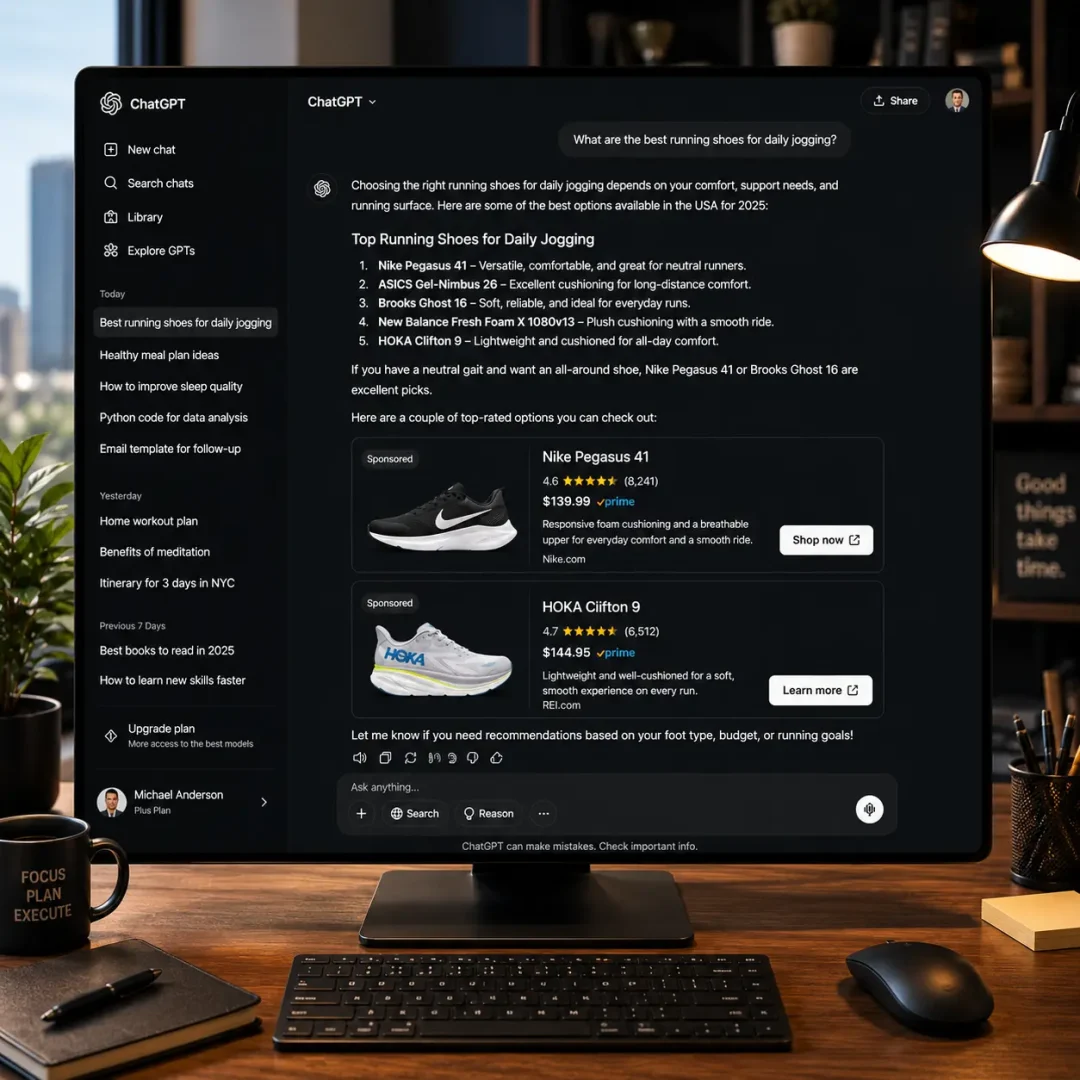
ChatGPT Ads — officially referred to as Sponsored Responses within OpenAI’s advertising ecosystem — are paid placements that allow businesses to appear within ChatGPT’s conversational responses. When a user asks ChatGPT a question that is relevant to your product or service category, your brand can appear as a clearly labeled, contextually relevant sponsored recommendation within the AI’s answer.
This is a fundamentally new type of advertising. Unlike Google Ads, where a user types a keyword into a search box and sees text ads above the organic results, ChatGPT Ads are embedded within a natural conversational response. The user asks a question, the AI provides a helpful, authoritative answer, and within that answer — clearly marked as sponsored — your business is recommended with a brief description and a call to action. The user has already received value from the interaction, which means they approach your brand recommendation with a much higher level of trust than they would a traditional ad.
OpenAI began rolling out its advertising platform in 2025, and ChatGPT Ads are now available to businesses across multiple categories including professional services, ecommerce, SaaS, healthcare, and home services. The platform is still in its early growth stage — which means competition is significantly lower than established platforms like Google Ads, Meta Ads, and LinkedIn Ads, and cost-per-click rates are considerably more affordable for comparable audience quality.
Why ChatGPT Ads Are Different from Every Other Ad Platform
To understand why ChatGPT Ads represent such a significant opportunity, it helps to contrast them clearly with every major ad platform currently available. Each platform reaches users in a different mindset and at a different stage of the buying journey.
Google Search Ads reach users who already know what they want and are actively searching for it. The intent is strong, but so is the competition — and so is the cost. For competitive keywords in digital marketing, legal services, or financial products, Google Ads CPC can exceed thirty to one hundred dollars per click. Google Display Ads reach a broad audience passively browsing other websites, with lower intent and lower engagement rates.
Meta Ads (Facebook and Instagram) reach users in a social browsing mindset — they are not searching for anything, but can be interrupted with a scroll-stopping ad. Meta is powerful for brand awareness, retargeting, and visual product categories, but intent is lower than search and privacy changes since iOS 14 have significantly reduced targeting precision.
LinkedIn Ads are highly effective for B2B targeting by job title, company size, and industry, but CPC rates are the highest of any major platform — often fifty to one hundred and fifty dollars per click for senior professional audiences.
ChatGPT Ads occupy a unique position. Users are in a research and consideration mindset — they are asking a question because they are trying to make a decision. They are not passively browsing and they are not in the final buying moment. They are in the middle of their decision-making process, which is precisely when a well-positioned brand recommendation can be most influential. The trust level is high because the recommendation comes embedded within a helpful AI response. The intent is high because the user is actively researching the topic. And the competition is low because most advertisers have not yet entered the platform.
| Platform | Audience Mindset | CPC Level | Competition |
|---|---|---|---|
| Google Search Ads | Active search intent | High — $15–$100+ CPC | Very high |
| Meta / Facebook Ads | Passive social browsing | Medium — $1–$5 CPC | High |
| LinkedIn Ads | Professional browsing | Very high — $50–$150 CPC | High |
| ChatGPT Ads | Research & consideration | Low — early stage | Low — first-mover window |
Our ChatGPT Ads Management Services
Audience Research and Conversation Intent Mapping
ChatGPT Ads targeting is based on conversation context — the topic, intent signals, and phrasing of the user’s query — rather than traditional keyword lists. Before we build a single campaign, we conduct deep research into the specific conversations your ideal clients are having with ChatGPT. We identify the exact questions, phrasings, and topic clusters that signal buying intent for your product or service.
This research involves manually testing hundreds of prompts across ChatGPT to understand how users ask about your service category, which words and phrases they use, what information they are seeking, and at what point in their query pattern they are most receptive to a service recommendation. We use this research to build a conversation intent map — a structured document that defines the precise targeting parameters for your campaigns and informs the creative strategy for your sponsored responses.
We also research your competitors’ presence on ChatGPT — testing whether they appear in sponsored or organic responses to target queries, what messaging they use, and where gaps exist that your brand can occupy. This competitive intelligence shapes our differentiation strategy and helps ensure your sponsored responses communicate a clear, distinctive value proposition
Campaign Architecture and Account Structure
A well-structured ChatGPT Ads account is essential for efficient budget allocation, clear performance measurement, and scalable optimization. We build your campaign architecture following a proven structure that separates campaigns by intent level (awareness, consideration, decision), by service or product category, and by geographic target market.
Each campaign contains multiple ad groups organized by conversation topic cluster. Within each ad group, we create three to five sponsored response variations for A/B testing. This structure gives us the granularity needed to identify which conversation topics, which ad copy approaches, and which CTAs are driving the best results — and to scale spend toward winning combinations while pausing underperformers.
We configure conversion tracking from the outset, connecting your ChatGPT Ads account to Google Analytics 4 via UTM parameters and setting up goal tracking for your priority conversions: form submissions, phone calls, free audit requests, or ecommerce purchases depending on your business model.
Sponsored Response Copywriting
Writing effective ChatGPT Ads requires a specialized skill set that is very different from traditional ad copywriting. A sponsored response must sound natural within a conversational context. It must be genuinely helpful — adding value to the user’s inquiry rather than being purely promotional. It must be concise, because ChatGPT users are reading a long AI-generated response and your sponsored section must earn their attention quickly. And it must include a compelling, low-friction call to action that feels appropriate within the conversational flow.
Our copywriters have studied the format of effective sponsored responses extensively and developed a proven framework for ChatGPT Ads creative. We open with a direct connection to the user’s query topic, immediately establish your brand’s credibility with a specific proof point (a certification, a result, a statistic), communicate the core value proposition in one to two sentences, and close with a low-friction CTA — typically a free audit, a free consultation, or a resource download rather than a hard sell.
We produce a minimum of five sponsored response variations per campaign at launch, giving us enough creative diversity to run statistically meaningful A/B tests within the first thirty days. We also write complementary landing page copy optimized for the mindset of a user arriving from ChatGPT — which is different from the mindset of a Google Ads visitor and requires a different messaging approach.
Landing Page Optimization for AI Traffic
One of the most common mistakes businesses make when running ChatGPT Ads is sending AI-referred traffic to a standard homepage or generic landing page designed for Google search visitors. Users arriving from ChatGPT have a different psychological context than Google Ads visitors. They have just received a conversational AI recommendation. They are in a research mindset rather than a buying mindset. They respond better to content that acknowledges their research context, provides deeper information, and earns their trust before asking for a commitment.
We audit your existing landing pages and develop recommendations for ChatGPT-specific landing experiences. These pages lead with credibility signals — your certifications, client results, and specific expertise — before moving to the service description. They include clear answers to the questions ChatGPT users are likely to have at this stage of their research. And they offer multiple conversion paths — a free audit, a downloadable guide, a consultation booking — to capture visitors at different levels of readiness.
Weekly Optimization and Performance Management
ChatGPT Ads optimization is an ongoing process that requires weekly attention during the first three months of a campaign as we gather performance data and identify the combinations of targeting, creative, and landing page that drive the best cost-per-acquisition for your specific business.
Each week we review campaign performance data including impressions, click-through rate, cost-per-click, landing page conversion rate, and cost-per-acquisition. We compare performance across ad groups to identify the conversation topic clusters driving the best results, and we adjust budget allocation to increase spend on top performers. We review A/B test results and rotate out underperforming creative variations. We update bid strategies based on conversion data.
We also monitor the broader ChatGPT Ads platform for new features, targeting options, and ad formats as OpenAI continues to develop the platform. Early adopters who are actively running campaigns receive advance notice of new capabilities and can adapt their strategy before the wider market
Multi-Channel Integration: ChatGPT + Google + Meta
The highest-performing advertisers in 2026 use ChatGPT Ads as part of a coordinated multi-channel paid media strategy. ChatGPT Ads excel at top-of-funnel brand discovery and mid-funnel research-stage engagement. Google Ads capture bottom-of-funnel active search intent. Meta Ads retarget website visitors who arrived via ChatGPT or Google but did not convert on their first visit.
When Clicks2Success manages all three channels for a client, we build cross-channel audience sharing into the strategy from day one. Visitors from ChatGPT Ads are added to Google and Meta retargeting audiences. Leads captured via Google Ads are excluded from top-of-funnel ChatGPT Ads to avoid wasted spend. Creative messaging is consistent across all three channels while being adapted for the specific context of each platform. Attribution is tracked through a unified GA4 setup that captures the full multi-touch customer journey.
| ChatGPT Ads (top of funnel) | Google + Meta (mid & bottom funnel) |
|---|---|
| Brand discovery in AI conversations | Capture active search intent |
| Research-stage buyer engagement | Retarget ChatGPT visitors |
| Lower CPC than Google Ads | Shopping and product catalog ads |
| High-trust conversational context | Lookalike audiences from AI visitors |
| Reach 200M+ daily AI users | Final conversion push |
| Build awareness before competitors do | Full attribution across channels |
ChatGPT Ads: Which Businesses Get the Best Results?
ChatGPT Ads deliver the strongest results for businesses selling considered-purchase products and services — categories where buyers research thoroughly before making a decision and where being present during the research phase is a significant competitive advantage.
- Digital marketing and professional services agencies — clients research multiple agencies before hiring
- SaaS and B2B technology companies — buyers evaluate multiple solutions before committing
- Legal, financial, and accounting services — high-stakes decisions with extensive research phases
- Healthcare and dental practices — patients research providers before booking appointments
- Ecommerce brands in competitive niches — product discovery during browsing and comparison
- Education, training, and coaching businesses — extensive research before enrollment
- Real estate agencies and property services — significant investment decisions with long research cycles
Is your industry a good fit for ChatGPT Ads?
If your target customers spend time researching their options before buying — and if they are the type of person who uses AI assistants for research — your business is a strong candidate for ChatGPT Ads. Book a free strategy consultation with our team and we will analyze your specific industry, target audience, and conversion goals to give you an honest assessment of expected performance and ROI before you commit any budget.
Our ChatGPT Ads Management Process — Step by Step
Step 1
Discovery and Strategy
Discovery and Strategy
We begin every engagement with a detailed discovery session covering your business goals, target audience, current paid media performance, competitive landscape, and budget parameters. We research your audience’s ChatGPT conversation patterns, map your conversion funnel, and produce a 90-day campaign strategy document with projected performance benchmarks, recommended budget allocation, and campaign structure.
Step 2
Tracking Setup and Account Configuration
Tracking Setup and Account Configuration
We configure your ChatGPT Ads account, implement UTM tracking parameters across all campaign links, set up conversion goals in GA4, and verify that all tracking is firing correctly before any budget is spent. This step is critical — many agencies skip thorough tracking setup and end up unable to measure the true ROI of their campaigns. We do not launch a campaign without complete, verified tracking.
Step 3
Creative Development and Campaign Launch
We write five to eight sponsored response variations per campaign, develop landing page recommendations, build the full campaign structure in your account, configure targeting parameters, and set initial bids. We launch with a conservative daily budget and monitor the first 72 hours closely, making rapid adjustments if early performance data indicates issues with targeting or creative.
Step 4
Optimization and Scaling
We optimize weekly for the first three months, running A/B tests, adjusting bids, and shifting budget toward top-performing ad groups and creative variations. By week twelve, most campaigns have sufficient conversion data to move into a scaling phase — increasing budget on proven performers and expanding to new targeting parameters and audience segments.
Step 5
Multi-Channel Expansion
Once ChatGPT Ads performance is stable, we integrate the campaign data with your Google and Meta Ads strategy. ChatGPT visitor audiences are added to retargeting campaigns. Top-performing sponsored response copy is adapted for Google responsive search ads. The combined multi-channel approach delivers the best overall cost-per-acquisition and lifetime customer value.
Industries We Serve
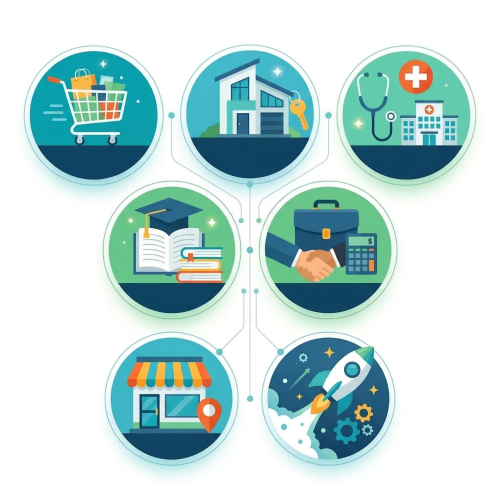
We work with businesses across a broad range of product categories, business models, and market positions, including:
- Fashion & Apparel
- Beauty & Personal Care
- Health & Wellness
- Food & Beverage
- Home & Lifestyle
- Sports & Fitness
- Electronics & Technology
- Subscription Box Businesses
- B2B & Wholesale eCommerce
FAQs About Chat GPT Ads Management Services
What are ChatGPT Ads and how do they work?
When someone asks ChatGPT a question related to your product, your brand shows up as a sponsored recommendation right inside the answer — with your name, a short description, and a link. You only pay when someone clicks.
How much does it cost?
Rates are lower than Google Ads right now since the platform is newer. We suggest starting with $1,000–$2,000/month in ad spend. Before you commit anything, we'll give you a free strategy call with cost estimates for your industry.
Can I run ChatGPT Ads alongside Google and Meta Ads?
Yes — and that's actually the best approach. ChatGPT Ads help people discover you while they're researching. Google Ads catch buyers ready to act. Meta Ads bring back visitors who didn't convert. Together, they cover the full buying journey.
How do you track results and ROI?
We set up full conversion tracking — clicks, form fills, calls, purchases. Every month you get a clear report showing what you spent, what you earned, and how each ad performed. Nothing hidden.
How quickly will I see results?
Campaigns go live within 2–3 weeks. You'll see early data (clicks and impressions) in the first month. Solid cost-per-lead numbers typically take 60–90 days. Most clients see improving results by month three.
Do you guarantee results?
No agency honestly can — ad results depend on your market, product, and platform conditions. What we do guarantee: weekly optimization, honest reporting, and clear communication about what's working and what we're testing.
What's the minimum commitment?
We recommend starting with 3 months — that's the time needed to properly test and optimize. After that, it's month-to-month with 30 days' notice to cancel. No long-term lock-ins.